
Planning permission for new builds in Cardiff: timing and process

For planning permission for new builds in Cardiff, Cardiff Council is the Local Planning Authority that decides applications. Most minor planning applications are decided within 8 weeks, while most major applications are decided within 13 weeks. A new build’s scale and site conditions can affect which process applies and how long a decision takes.
It’s understandable to focus on the deadline, but planning permission for new builds in Cardiff involves more than waiting for a decision. Cardiff Council assesses proposals against planning policy and relevant considerations, while consultation and site-specific details can shape how an application progresses.
This guide explains how Cardiff’s planning system works, what decision times mean and why factors such as flood risk, biodiversity and infrastructure matter. You’ll also learn how a well-prepared application can clarify the route from an initial proposal to a planning decision.
Table of Contents
How long does planning permission take in Cardiff?
Most minor applications in Cardiff are decided within 8 weeks; most major applications take 13 weeks. These are usual decision periods, not a measure of every stage before submission. Cardiff Council processes approximately 3,200 planning applications per year, across different types of development and levels of complexity.
Application type matters. A new home proposal is generally considered through a full planning application, while some changes may use other routes. Cardiff’s tracked planning records included 440 applications categorised as Full between 2025-08-04 and 2026-09-30. The same dataset recorded 234 applications concerning conditions, representing 16% of applications. These figures show why checking the application category and decision being sought matters.
To see how comparable proposals progressed, use Cardiff Council’s planning application search to review recent applications by address, proposal or application type. Records can include submitted plans, consultation responses, officer assessments and decisions. Compare like with like: a new dwelling on a constrained plot may raise different issues from one on a serviced site.
What documents and plans are required for a Cardiff planning application? Provide the application form, a location plan and site plans showing the proposal and its relationship to neighbouring properties. Elevations and a design statement can explain the building’s appearance, layout and context. Any additional reports depend on the site and proposal.
Cardiff planning applications usually have a 21-day public consultation period for objections. Neighbours can comment, but Council decisions must be based on evidence and relevant material considerations; public opposition alone is not a valid reason for refusal. The council weighs the planning merits, not simply the number of objections.
What are the appeal options if Cardiff Council refuses planning permission? A judicial review must be lodged within six weeks, according to UK legislation. It examines whether the council followed the correct process, rather than reconsidering the development’s merits.
How much are Cardiff planning application fees for a new build? The fee depends on the application category and proposal, including the development type and scale. The applicable charge is provided during the application process.
How does the planning system work?
Cardiff Council assesses proposals under Welsh national policy and its local planning framework. The Local Development Plan and supporting guidance help determine where homes can be built and how they should be designed.
Welsh planning policy and local plans
Wales uses Future Wales: The National Plan and Planning Policy Wales, rather than England’s NPPF. Planning Policy Wales Edition 12 sets national direction, whilst Technical Advice Note 12 covers design expectations. Cardiff’s adopted Local Development Plan was adopted in 2016 and covers 2006-2026; a replacement is in progress. The plan’s housing target is approximately 1,700 homes per year, and it should be revised every four years. Cardiff’s Supplementary Planning Guidance, including SPG16, guides officers but is not legally binding. Its relevance depends on the proposal and the planning issues it raises.
Local plans also identify strategic development locations. Plasdwr, in north-west Cardiff, is planned to deliver up to 7,000 homes. Northern Meadows is allocated for up to 5,000 homes. At Glan y Coed and The Parish, Persimmon and Charles Church are delivering up to 1,250 homes. These figures show how allocations connect housing growth with a site’s wider planning context; they don’t mean every plot has automatic consent.
Permitted development rights and restrictions
Permitted development rights allow certain works without a full planning application, provided the proposal falls within their scope. They do not give blanket approval for every type of building work. The proposal’s nature, scale and location, as well as any site-specific restrictions, can affect whether these rights apply. For a new dwelling, distinguish a site’s allocation in a local plan from permission for its actual design. This helps establish whether a full application is needed.
Planning Application Management can organise an application around the proposal and its policy context. Understanding Cardiff’s Local Development Plan, relevant guidance and the limits of permitted development rights gives you a clearer basis for planning the next stage.
Flood risk, biodiversity and infrastructure considerations
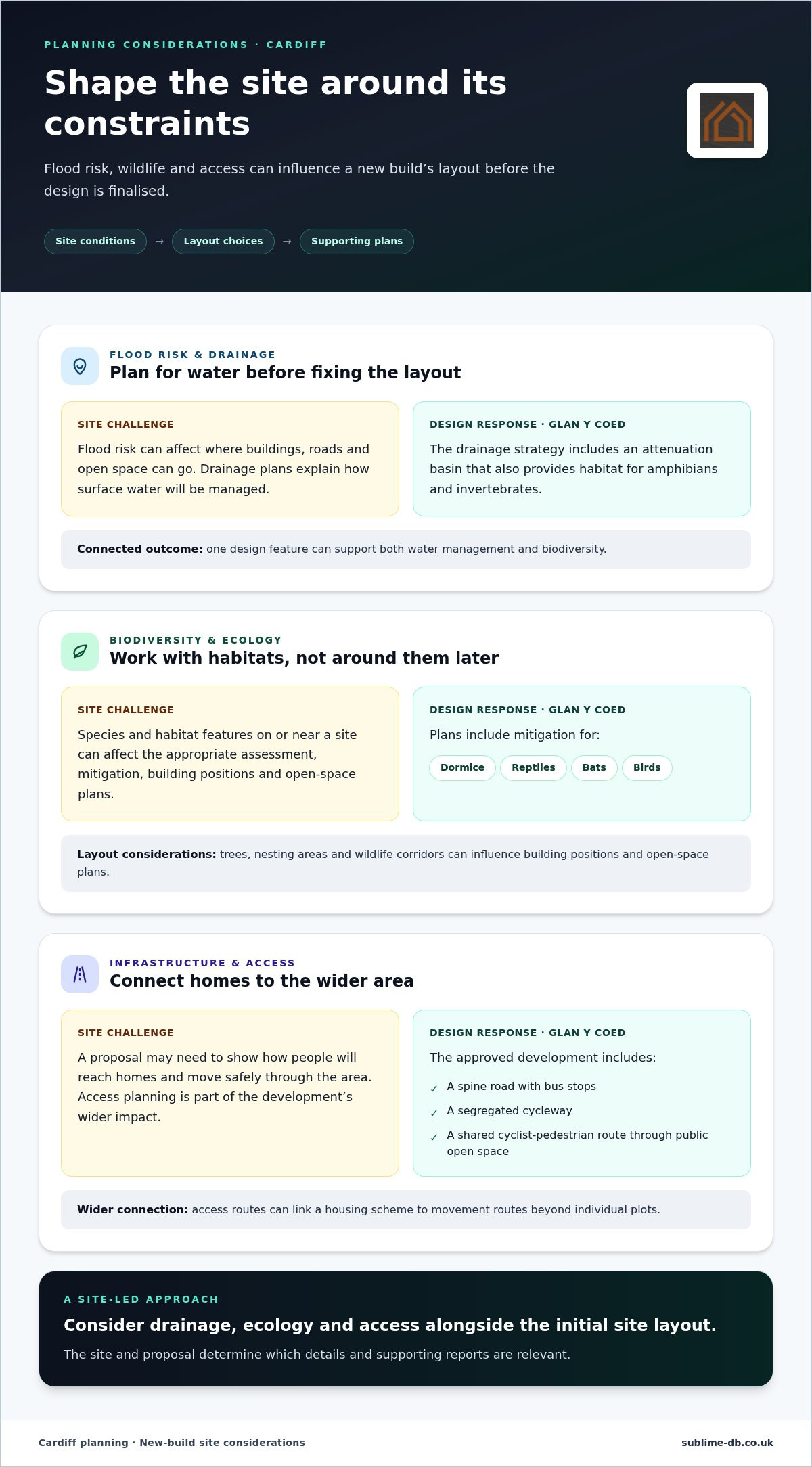
A Cardiff site’s drainage, ecology and access can shape its layout before the design is finalised. Flood risk affects where buildings, roads and open space can go, while drainage plans explain how surface water will be managed. At Glan y Coed, the drainage strategy includes an attenuation basin that also provides habitat for amphibians and invertebrates. This shows how one design feature can support both water management and biodiversity.
Ecological constraints can influence when and how site work is arranged. Glan y Coed’s plans include mitigation for dormice, reptiles, bats and birds. On another site, the species present and habitat features on or near the land help determine the appropriate assessment and mitigation. Designing around trees, nesting areas or wildlife corridors can affect building positions and open-space plans, so consider these matters alongside the initial site layout.
Infrastructure is also part of a development’s impact. A proposal may need to show how people will reach homes and move safely through the area. At Glan y Coed, the approved development includes a spine road with bus stops, a segregated cycleway and a shared cyclist-pedestrian route through public open space. These elements show how access planning can connect a housing scheme to wider movement routes, rather than treating each plot in isolation.
For a new build, these considerations are linked. A drainage basin may use land that could otherwise accommodate buildings, while ecological mitigation can shape roads or landscaping. Cardiff’s Glan y Coed example combines drainage, habitat provision and transport infrastructure, showing how coordinated design can respond to several site needs. Early site appraisal helps identify constraints, inform the building footprint and bring supporting evidence into the planning proposal. This gives decision-makers a clearer account of how the development fits its surroundings and manages its effects.
Cardiff Council as Local Planning Authority
Cardiff Council is the Local Planning Authority for applications in Cardiff. It assesses each proposal against planning policy, relevant material considerations and the evidence submitted. The decision is not simply a count of objections or an application of a standard design template. It turns on the proposal’s planning merits and the evidence specific to the site.
That distinction matters during consultation. Cardiff applications usually have a 21-day public consultation period, when neighbours can comment on matters such as access, overlooking or the effect on local character. The Council must consider relevant points, but public opposition alone is not a valid reason to refuse permission. A clear response explains how the proposal addresses planning concerns, rather than treating the number of objections as the deciding factor.
The Council also assesses whether a proposal needs supporting obligations to address its effects. In Welsh planning, Section 106 agreements can secure planning obligations linked to a development. Cardiff Council has negotiated more than £100,000,000 in Section 106 contributions since 2016/17. For an applicant, this shows why the planning decision can involve more than the building’s footprint: the Council may consider what measures are needed to make a proposal acceptable in planning terms.
Cardiff Council’s published planning records let you follow an application’s progress and understand the decision. Read the officer’s assessment alongside the submitted plans and consultation comments. This helps distinguish a planning objection from a material planning issue and shows which parts of the design or evidence influenced the outcome. For example, a concern about a new access can be considered against the access plans and the Council’s assessment.
Preparing a proposal around relevant policy, site evidence and consultation issues gives the Council a coherent basis for assessment. If you’re developing a new home, discuss your planning application as part of shaping the proposal and its supporting information.
Sublime Design & Build: Planning Application Management
Sublime Design & Build provides Planning Application Management for homeowners planning a new build or extension. This service helps organise the application as part of the wider project, linking the proposal with the next stages of design and construction.
This support is useful when you’re developing a proposal for a specific site and need to include planning in the project plan. Sublime Design & Build also provides New Builds and Building Regulations Compliance, helping homeowners progress from the application stage towards the technical requirements for construction.
For a project that includes planning, design and building work, a joined-up approach can make responsibilities and next steps clearer. Visit sublime-db.co.uk to discuss your project with Sublime Design & Build.
Shape your next step with confidence
Before settling on a design, consider the planning strategy alongside the intended build. Thinking about how the home will function, how the site will shape its layout and what information the proposal needs can help you make informed decisions from the outset. Planning permission for a new build in Cardiff is one part of a wider project, so plan ahead for the technical requirements and construction that follow.
Sublime Design & Build Ltd brings Planning Application Management, Building Regulations Compliance and New Builds together in its residential project work. This provides a practical route from preparing an application to progressing the home itself, with the details shaped around your project.
If you're ready to discuss your plans, contact Sublime Design & Build Ltd today. A clear next step can help turn your ideas into a considered plan for the home you want to build.
Frequently Asked Questions
It sounds like the Planning Committee has to almost operate like a court then?
No. Cardiff’s Planning Committee considers planning applications; it isn’t a court conducting a trial. Members assess the proposal against planning policy and relevant evidence, rather than deciding who has won an argument. Public comments can raise issues such as access or effects on neighbours, but the number of objections alone doesn’t determine the outcome. The decision concerns the proposal’s planning merits.
Ok, under the law, what is the Local Planning Authority able to take into consideration when looking at an application?
Cardiff Council can consider material planning matters connected to a proposal. These may include the development plan, design and effects on local character, access, neighbouring amenity, flood risk, biodiversity and infrastructure. For example, a new home’s position and windows may raise privacy concerns, while its access arrangements may affect how vehicles enter the site. Personal objections unrelated to planning do not determine the decision.
Does a new build in Cardiff require planning permission?
A proposal to build a separate new home will generally need planning permission. Don’t assume permitted development rights cover a new dwelling. The route depends on the proposal and site, including any applicable restrictions. A housing allocation in Cardiff’s Local Development Plan does not approve a particular design. Planning consent is also distinct from Building Regulations Compliance, which addresses technical standards for construction.
Which Cardiff Local Development Plan policies apply to new-build homes?
The relevant policies depend on the site and proposal, so no single policy applies to every new home. Start with Cardiff’s adopted Local Development Plan and consider policies on housing location, design and development impacts. Welsh national policy and relevant Cardiff supplementary guidance also inform the assessment. For a specific plot, the proposed use, layout and constraints determine which policies apply.
What types of new builds are permitted development in Cardiff?
Don’t treat permitted development as a general route for building a separate new home. These rights apply to defined categories of development and have limits; whether they cover particular work depends on its nature and the site circumstances. Work within an existing home, for example, is different from creating a new dwelling. Establish the correct planning route before relying on permitted development rights.
How do I apply for planning permission for a new build in Cardiff?
Start by defining the proposal and identifying the site’s planning constraints. Then prepare application material that explains the design and its effects. Clear drawings should show the site, proposed layout and building elevations, with supporting information tailored to issues such as access or ecology. Submit the application to Cardiff Council, then follow its published record for consultation, officer assessment and the decision.
Comments