
Block paving driveway patterns in Bristol: ideas for a considered design

The best-looking driveway pattern is one that suits the space as well as making everyday parking straightforward. Choosing block paving driveway patterns Bristol homeowners will enjoy starts with the shape of the driveway: a narrow approach, turning area or prominent entrance can all affect how a layout looks and works. Names such as herringbone, stretcher bond and basket weave are easier to compare when you picture their direction and rhythm across your own driveway.
The pattern is only one part of the design. Block colour, borders and the relationship with your home and garden all help the driveway feel considered rather than like an isolated surface. This guide compares popular patterns, explains how driveway shape and parking movements affect their appearance, and offers a simple way to narrow down your choices. Sublime Design & Build Ltd brings driveway and patio projects together with wider residential design and construction, including 3D visualisations.
Table of Contents
Block paving driveway patterns in Bristol: begin with the space
A striking driveway photo can be a useful starting point, but the same pattern won’t create the same effect on every plot. The frontage, shape of the drive and position of the entrance influence how paving looks from the street and feels in daily use. When comparing block paving driveway patterns in Bristol, match the layout to the property rather than choosing by pattern name alone.
Look at the space as a whole. A broad, regular frontage may give a pattern room to repeat clearly, while a narrow drive or one that changes direction can make the same layout feel busier. Consider where cars enter, turn and park, and how people will reach the front door without crossing awkwardly between vehicles. These movements affect where the pattern’s lines lead and where borders or changes in direction might sit.
Keep the paving pattern distinct from the wider design. The pattern describes how the blocks are arranged; colour, edging and borders set its visual frame. A contrasting border can define the driveway’s shape, while a similar-toned edge may create a quieter transition to a path or garden. For a general introduction to block types and familiar arrangements such as herringbone and stretcher bond, the Paver overview provides useful context.
What to look for in a Bristol driveway before choosing a pattern
Walk the driveway from the pavement to the parking area. Note its width and length, any bends or changes in level, and where vehicles enter, turn and stop. Then consider how the front door, garden boundaries and existing exterior finishes frame the paving. Bristol, Newport, Cardiff and Monmouthshire all include a variety of homes and plot shapes, so a design that suits one frontage may not feel balanced on another.
Check the proportions: note whether the drive is long and narrow, broad and open, or divided into sections.
Map everyday movement: consider turning and parking positions alongside a clear route for pedestrians.
Read the setting: look at walls, planting, paths and the home’s exterior finishes as part of the composition.
How to use driveway photos as design inspiration
When a paving photo catches your eye, compare the example’s scale and shape with your own driveway. A layout shown across a large, rectangular space may look quite different around a narrow entrance or angled boundary. Look beyond colour: trace the direction of the blocks, notice whether there’s a border, and see how the paving meets walls, paths and planting edges.
Save images that show details you like, not just complete driveways. One might offer a useful border idea, while another shows a pattern direction that could suit your frontage. Treat each as a prompt for design discussion, not a precise preview: the finished composition depends on your property’s dimensions, access points and surrounding features. This gives you a clearer starting point for developing a design that fits the site.
How Bristol driveway layout changes the look of block paving patterns
A pattern’s name tells you how blocks are arranged, but not exactly how that arrangement will read across your driveway. The same layout can appear orderly on a straight approach and more animated where the space widens or turns. Use the comparison below as visual guidance, not a fixed rule: the proportions of the property and direction of travel influence the overall effect.
Herringbone and stretcher bond: direction and visual rhythm
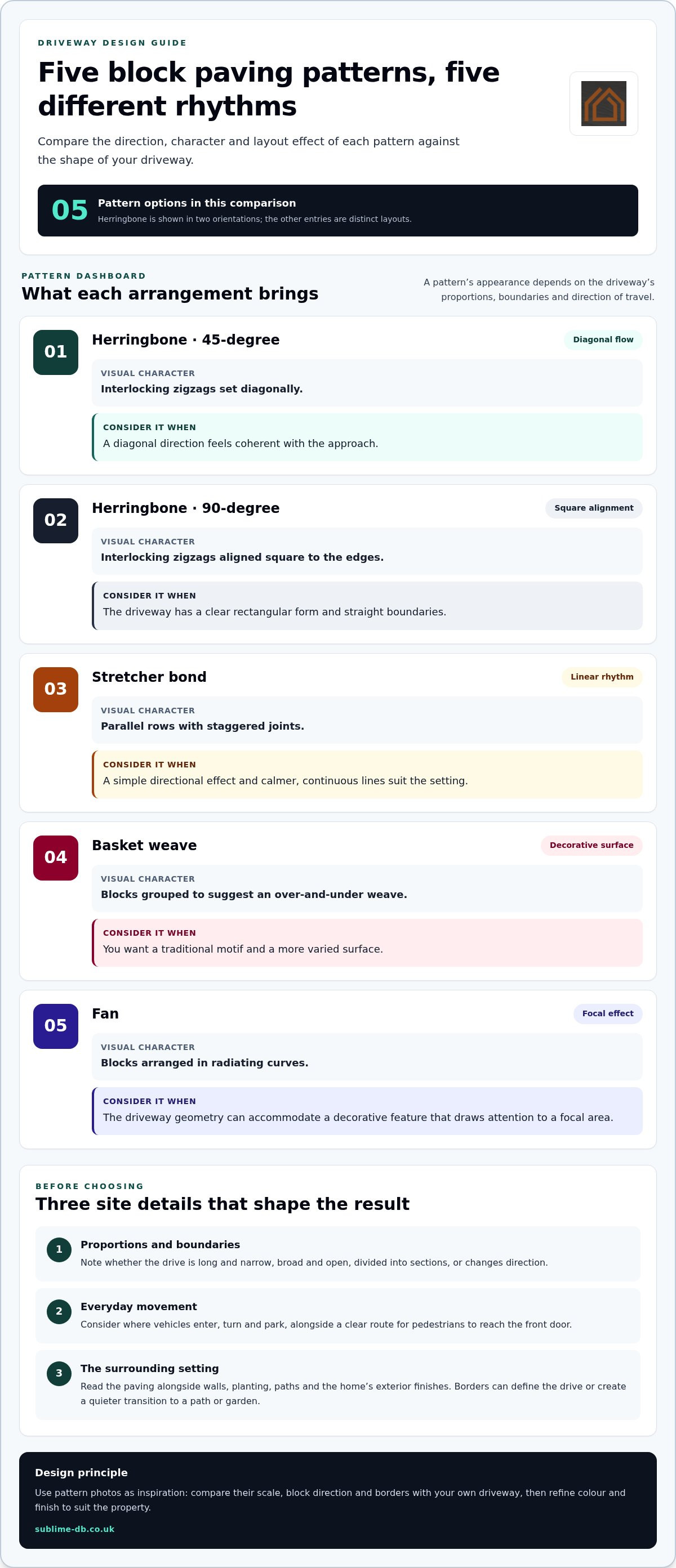
Herringbone forms a repeated zigzag, with each block meeting its neighbour at an angle. In a 45-degree layout, the zigzags run diagonally across the driveway; at 90 degrees, they sit square to its edges. Stretcher bond uses staggered rows, so its lines feel more continuous. On a long, straight approach, those rows may be especially noticeable, while a bend can change how their direction is perceived. Compare each layout against the driveway outline to see which feels more in keeping with the approach.
Basket weave and fan patterns: character and focal points
Basket weave groups blocks into alternating squares, creating a woven impression rather than continuous diagonal or linear movement. Fan patterns spread out in curved sections, giving the paving a decorative focal effect where the shape can accommodate them. These motifs draw the eye differently from simpler directional layouts, so consider whether you want the surface to feel quietly ordered or to become a feature in its own right.
Pattern choice is a design decision, not a description of the groundwork. A pattern name doesn’t specify the sub-base, preparation or standard of installation. Those are separate parts of construction, planned around the project rather than inferred from the blocks’ arrangement. The finished appearance also depends on how the layout meets boundaries, entrances and changes in direction.
When comparing block paving driveway patterns in Bristol, picture each option across the actual footprint rather than judging a sample in isolation. A considered design brings the chosen layout together with the shape and character of the property. Sublime Design & Build Ltd’s driveway work can take that thinking from an idea towards a finished outdoor space.
Compare block paving driveway patterns for Bristol homes
Once you understand how each arrangement is formed, compare the impression it creates across the whole driveway. Does it lead the eye towards the house, run alongside the approach, or draw attention to a central feature? The table offers a starting point for weighing traditional, linear and decorative effects. It’s a guide, not a ranking: how a pattern feels depends on the proportions and setting of the individual property.
These effects aren’t fixed. A light block with a subtle border may read quite differently from the same arrangement in contrasting colours. Block scale matters too: larger or smaller units change how frequently the pattern repeats across a given area. Borders can contain the design, extend its lines or add another point of emphasis. Consider these elements together rather than deciding on the laying pattern in isolation.
Which block paving pattern suits a narrow or compact driveway?
On a compact drive, uninterrupted lines or a consistent repeated layout can give the surface a more ordered impression. The direction of those lines matters: a layout running lengthways may draw attention along the approach, while a crosswise or diagonal arrangement changes the visual movement. A contrasting border can define the edges more clearly, but may also make them a stronger feature. These are design considerations, not guaranteed ways to make a space look larger.
How to balance decorative patterns with the home's exterior
Match the pattern’s character to the house and its existing materials. A decorative motif may sit comfortably with traditional details, while a more restrained layout can complement a simpler exterior. If the centre of the drive has a strong pattern, a quieter border can frame it without competing for attention. Compare reference images as complete compositions, including the house, edges and surroundings, rather than focusing only on an attractive block detail.
To shortlist block paving driveway patterns for a Bristol home, compare each option against the frontage, the direction you want to emphasise and the property’s overall character. The best fit is the one that brings those elements into balance, not a pattern assumed to suit every home.
Plan a block paving pattern for your Bristol driveway
A few clear notes about the site make pattern ideas easier to assess. Rather than choosing from photographs alone, build a short design brief that connects the driveway’s shape with the way your household uses it and the look you want. This lets you compare options on the same terms and gives design discussions a practical starting point.
Record the site. Note the driveway’s dimensions, entrance and exit points, boundaries and any changes in direction. Mark where the paving meets the pavement, garage, garden, paths or existing outdoor surfaces.
Define daily use. Sketch where vehicles enter, turn and park, along with pedestrian routes and any shared access. Include regular movements, not just the ideal parking arrangement.
Shortlist patterns. Choose a small range of layouts to compare against the recorded shape and movement. Consider whether each pattern’s direction works with the approach and boundaries.
Refine the finish. Compare block colour, scale, borders and edging as part of the complete composition. Look at samples or reference images in the setting of your own home.
Turn driveway dimensions and vehicle movements into a design brief
A simple plan doesn’t need to be a technical drawing. Mark the entrance, exit, parking positions, turning area and pedestrian route, then note where the surface meets a garage, pavement, garden or another outdoor finish. If access is shared, show the parts used by others too. This gives you a practical way to judge whether a proposed pattern direction feels consistent across the full layout.
Bring the brief together with photographs taken from the street and from the house. When comparing reference images, look for a similar driveway shape and scale, then consider how the paving meets boundaries and changes direction. A picture can suggest a useful idea, but it can’t predict exactly how the pattern will sit on a different property.
Bring the driveway pattern together with the wider outdoor space
Think beyond the driveway surface. A path leading to the front door, a patio at the side of the house or planting beside the boundary can all affect how the paving feels as part of the garden. If your project includes connected outdoor areas, these patio design ideas for South Wales can help you consider how the spaces relate. If the driveway sits within wider home changes, the home renovation feasibility guide offers a broader planning perspective.
Use this process to turn inspiration into a considered shortlist for block paving driveway patterns suited to homes in Bristol, Newport, Cardiff and Monmouthshire. Sublime Design & Build Ltd brings residential driveway and patio work together with wider design and construction capabilities. To move from early ideas towards a coordinated outdoor project, explore driveway design and construction.
From Bristol block paving pattern ideas to a finished driveway
A pattern shortlist is most useful when it helps shape a driveway that suits the way you use the space and the character of your home. Rather than treating a pattern as a ready-made solution, consider how it relates to the site plan, parking movements, entrance and outdoor setting. The aim is a coordinated design, where the paving feels like part of the property rather than a separate feature at the front.
Develop a coherent design from pattern shortlist to site plan
Compare your preferred options against the driveway’s actual proportions and boundaries. A layout that looks balanced in a photograph may need to be adjusted around an angled edge, a path or a change in direction. Consider how the pattern meets the entrance and connects visually with nearby garden areas, then refine the block colour, borders and edging as elements of the same composition.
Keep the design discussion grounded in the specific property. Sublime Design & Build’s wider design-and-build offering includes 3D visualisations, which can help communicate design ideas as part of a project. The aim is to develop a considered scheme for the home and site, rather than apply a standard pattern formula to every driveway.
Explore driveway design and construction in Bristol
Sublime Design & Build provides residential design and construction services in Bristol, including driveways and patios. A project can move from discussing the brief and intended layout through to construction, with design decisions considered in relation to the home’s approach and wider outdoor space. Where patio and driveway areas meet, considering their relationship can help create a more joined-up result.
As the design takes shape, the pattern remains one part of the overall plan. Access, parking positions and connections to paths and boundaries all contribute to how the finished surface works and looks. Bringing those details together early keeps the project focused on the particular property, rather than on a pattern in isolation.
For homeowners comparing block paving driveway patterns in Bristol, Newport, Cardiff and Monmouthshire, there is plenty of visual inspiration. A successful choice comes back to the site, everyday use and the home’s character. A clear brief gives the project a practical starting point, while professional design and construction can carry those ideas towards a finished outdoor space.
If you’re ready to take the next step, Discuss your Bristol driveway project with Sublime Design & Build.
Give your driveway idea a clear next step
A strong design doesn’t need to begin with every detail settled. Start by choosing what matters most to you: a clear sense of arrival, a practical approach to parking, or a finish that sits comfortably with the home. Use that priority to guide the conversation, then develop the pattern shortlist into a design specific to your property.
If you’re weighing up block paving driveway patterns in Bristol, bring the idea you’re drawn to and the questions you’d like the design to answer. A focused discussion can turn early inspiration into a coherent direction for the project, without forcing your home into a standard template.
Sublime Design & Build can help take you from an initial idea towards a considered driveway project. Discuss your Bristol driveway project with Sublime Design & Build and start shaping an outdoor entrance that feels right for your home.
Frequently Asked Questions
Which block paving pattern is best for a driveway?
No single pattern is best for every driveway. When comparing block paving driveway patterns in Bristol, start with the shape of the space and how vehicles move through it, then consider the effect you want. A fan motif might suit a defined feature area, while a simpler layout may feel more in keeping with an understated frontage. View examples at a similar scale to your own property before settling on a shortlist.
Is herringbone block paving suitable for a driveway?
Herringbone is a widely used driveway layout, but its suitability depends on the site and the design you want. Its zigzag arrangement can make the paving visually prominent, so consider how it sits beside a plain path, brick façade or detailed boundary wall. Look at both 45-degree and 90-degree examples in context, and assess how the chosen direction relates to the approach and parking area.
Can block paving patterns be combined on one driveway?
Two layouts or a separate border can be combined if there’s a clear reason for the change. For instance, a border might distinguish the driveway from a path or mark a transition between areas. Before deciding, check how the pattern change meets corners and edges, and whether it remains visually balanced from the street. Too many competing details can make the surface feel cluttered, particularly on a compact frontage.
What is the difference between 45-degree and 90-degree herringbone?
The terms describe the angle of the herringbone layout in relation to the driveway’s edges. Both use a repeated zigzag, but the 45-degree arrangement sits diagonally, while the 90-degree version is aligned square to the edges. To compare them, view each against the same outline of your driveway. Pay attention to how the pattern meets the entrance and boundaries, as these junctions can affect the overall impression.
How do I keep weeds from growing between block paving?
Regularly sweep away leaves, soil and other debris before it settles in joints or along the edges, and remove small weeds early. If using a cleaning product, follow its instructions and make sure it’s suitable for the paving. Avoid forceful methods that could dislodge jointing material or damage blocks. Persistent growth may be a sign that joints need attention, so consider the condition of the surface as well as visible weeds.
Can individual blocks be replaced if they become damaged?
Often, a damaged block can be replaced individually, although the surrounding area and cause of damage matter. A replacement may look different if the original blocks have weathered, so compare colour and finish carefully. If nearby blocks have shifted too, replacing only the visibly damaged one may not address the underlying issue. The repaired area should sit level with surrounding paving, with the joints reinstated to match the surface.
Does a block paving driveway need planning permission in Bristol?
It depends on the property and the proposed driveway, so there isn’t one answer for every Bristol address. Surface-water arrangements and site-specific circumstances can affect what requirements apply. Check current Bristol City Council planning guidance and relevant national sources for your proposal before work starts. If the property is listed or in a conservation area, or the design changes drainage, verify the requirements for that particular site rather than relying on a general rule.
Comments